
Control, Discipline, and Indulgence
Big BrotherThis flow traces how control shifts from Fletcher’s routines to Pandora and Edison’s extreme regimen, revealing that strictness and indulgence can become parallel forms of dependence.
increasing Bearing strength in each event
 decreasing
Bearing strength in each eventdecreasingFletcher’s Regime

Control in the Household
Fitness becomes ritual
Fletcher cycles long distances and adopts a restrictive diet, partly as a response to the disorder of his earlier marriage. His self-discipline makes him feel secure but also leaves Pandora feeling judged.
Resistance takes another form
Pandora answers his food rules with contraband desserts and deliberate indulgence. Neither response is simply about nutrition; both express a struggle over who sets the terms of domestic life.
Edison’s Excess
Food as Compulsion
Eating exceeds appetite
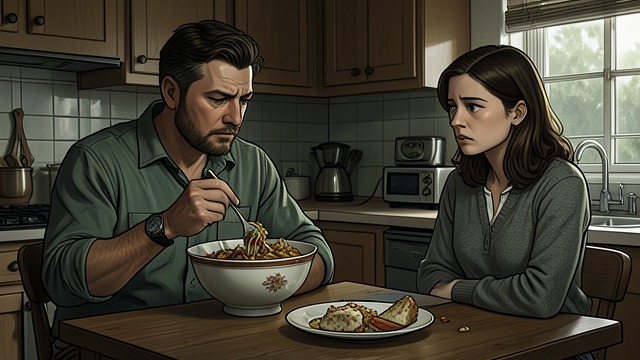
Edison consumes enormous portions and eventually eats pantry ingredients in secret. Pandora sees that this behavior does not resemble ordinary hunger or pleasure, even though he initially dismisses her concern.
Control fails through concealment
His overeating is not simply a lack of rules: it is a hidden pattern that continues despite its costs. The more the family watches and judges him, the more secrecy and defensiveness shape their responses.
One Strict Rule

Discipline as Relief
A single decision
Pandora proposes an uncompromising liquid plan rather than a long list of daily choices. Edison accepts the rule, and strict adherence becomes easier to measure than the reasons he eats.
Control changes hands
Pandora becomes the supervisor and Edison the person being supervised. The arrangement offers immediate structure, but it risks replacing one extreme with another rather than building flexibility.
Perfect or Nothing

Abstinence Turns into Identity
The appeal of being perfect
Pandora tells Oliver that it feels easier to follow the rule absolutely than to be only a little bad. She begins to see eating as a threat to the purity of their shared project.
A warning from outside
Oliver recognizes that her discipline has become a dangerous form of control and insists she eat soup. Pandora’s fear of a single bowl shows that strictness has crossed from useful structure into harm.
Life After the Rule

Control Cannot Be the Goal
A new dependence
Edison has become devoted to measuring food and maintaining the regimen, and Pandora worries that he cannot trust himself beyond rigid controls. The plan has changed his behavior without fully resolving his relationship to eating.
Ordinary life remains difficult
The novel’s imagined recovery eventually gives way to relapse, while the factual account ends without a rescue. Both versions question whether control alone can produce a durable, meaningful life.
Before Edison’s arrival
During the two-month visit
At the start of the apartment regimen
During Pandora’s fourth month of dieting
After Edison reaches his target in the imagined account
